Sunday, 14 April 2019

Claire's Collection

Just over two weeks ago, I made a four hundred mile train journey to Cornwall to visit my friend and fellow dolls' house collector Claire. With me was my friend and fellow dolls' house collector Brooksey.


Claire had arranged for us to stay in a gorgeous little holiday cottage which will be four hundred years old next year.


The cottage is in the little costal village of Kingsand on the Rame peninsular and the beach was only a 200 yard stroll away. And look at the weather - it was perfect!

Not that we had time for sunbathing or sightseeing as we had a full-on, dolls' house-packed itinerary to get through.....


First off was Claire's own collection.

I have been friends with Claire for about six years now and during that time we've met up several times, we chat on the telephone every week (boy can we chat!) and we've shared countless photographs of our collections. However, nothing could have prepared me for seeing her collection 'in the flesh' for the very first time.


Having collected dolls' houses and miniatures with a passion for many years and having been fascinated by all things tiny from a very young age, she has managed to accumulate the most amazing collection of houses, furniture and well... stuff!


Oh and little dolls. Hundreds of little dolls - she's not affectionately known as Bobadoll for nothing!


A lover of Lines/Triang (amongst other things), she has some fab examples, including this biggie - the capacious Triang DH/12 which is nearly four feet wide.


And a lovely Triang No. 80.


Here we have a Triang DH/3 - I wish I had photographs of the insides too - they're all packed to the gunnels with amazing treasures.


I was particularly pleased to see this lovely G&J Lines No. 32 (aka a "Half Kits Coty") as I made the replacement sloped roof piece with the window and widows' walk on it for Claire a few years ago (apart from the turnings which were made by Cliff Hirst) and it was great to see it in situ.


The windows on this G&J Lines No. 37 (I do hope I'm getting the numbers right!) are the beautiful tin litho ones. This house was one of Claire's legendary bargain buys, costing the grand sum of £6.50!


This is the official "Dolls' House Room" in Claire's real house. I suspect it filled up and overflowed many years ago!


Anyone who knows Claire will know that she has long been a fan of Barton and has a very comprehensive collection of Barton dolls' house furniture. She also has no less than three of the rarely seen Barton houses.


Tucked away on the upstairs landing we have a towering Lundby dwelling.


One of the wonderful things about Claire's collection is that it is truly eclectic.

The more modern white property in the centre of this photo has been made into a fabulously groovy Pippa fashion boutique which really takes me back to my childhood!

The huge castle to the left of it is relatively modern too and is beautifully and imaginatively decorated in a quirky gothic style.


This huge, early 20th Century house has been beautifully furnished and is packed with mouth-watering treasures!


And talking about packed with treasures.....this is Peggoty Leggoty's house. Every room is a feast for the eyes. This is one of the few houses I remembered to photograph the interior of (I'm always too engrossed and forget!)

For some reason, however, I forgot to take a photo of the exterior...😊


Finding just one of those little wooden eggs with a tiny peg doll in it would make my day!


I could have spent a whole week looking at just this one house.
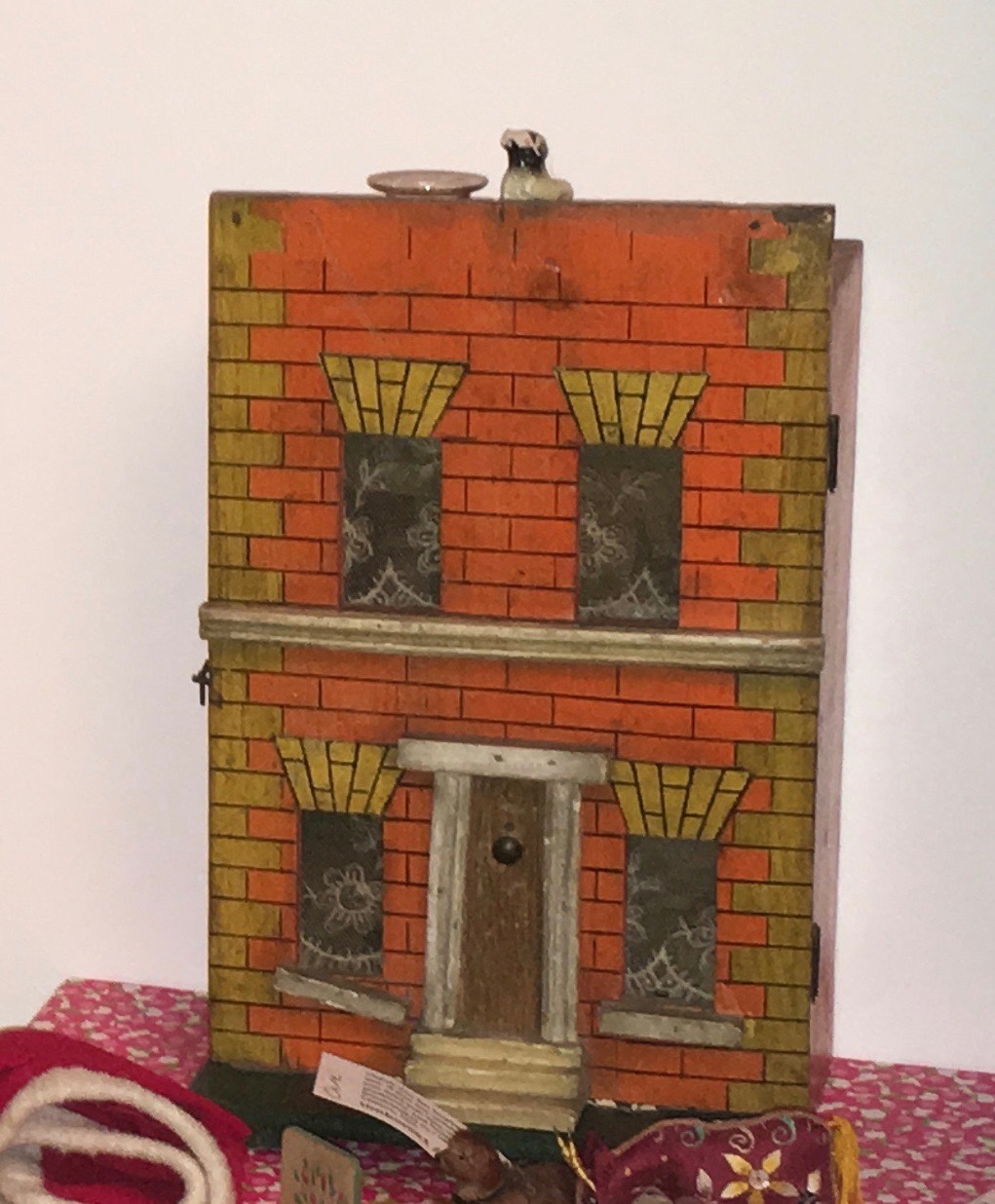

Back to exteriors and next there is this tiny Silber & Fleming type house - home to a group of lucky wee Grecons.


And this beautiful, larger Silber & Fleming - lovingly rescued from under a layer of white gloss paint.


I love the bays, the arched window and the balcony on this beautiful house.


This interesting house has, most unusually, bay windows on two sides and is currently being beautifully furnished with stylish treasures from Bassett-Lowke as well as the rare Triang 1930s 'modern' dining suite.


This one is a more modern box back, beautifully crafted by Frances England. And you might just be able to see some very rare pieces of Ladies Guild furniture in the upstairs room (as seen on The Antiques Roadshow!)


There is a more modern shop....


....or two.  This is the eccentric Madam B's shop of weird and curious objects. Believe me, Claire had no shortage of "weird and curious objects" with which to stock this shop since her taste is, by her own admission, somewhat quirky. And, I would add, fab!

This is 'Mouse Castle', home to quite a number of cute little vintage cloth mice, and complete with an imprisoned kitty in the dungeon! I'm kicking myself for not photographing the busy, quirky interior - especially the nursery with a line of adorable little cradles made from walnuts shells.  

Incidentally, I had a good play with the Sooty, Sweep and Sue glove-puppets you can see here too - I loved watching them on TV as a child, and I have to confess that since I've returned home I've acquired a set of my own! Sweep has a squeaker - how fab is that!!!


Ahem, anyway, back to the collection. This is Bartons Antique shop (run by Dolly Barton!) - a shop I could spend an entire day browsing in.


Here we have some wonderful vintage shops - a Binbak doll shop on the left and a rare Barton toy shop on the right - both packed and overflowing with mouth-watering mini toys.
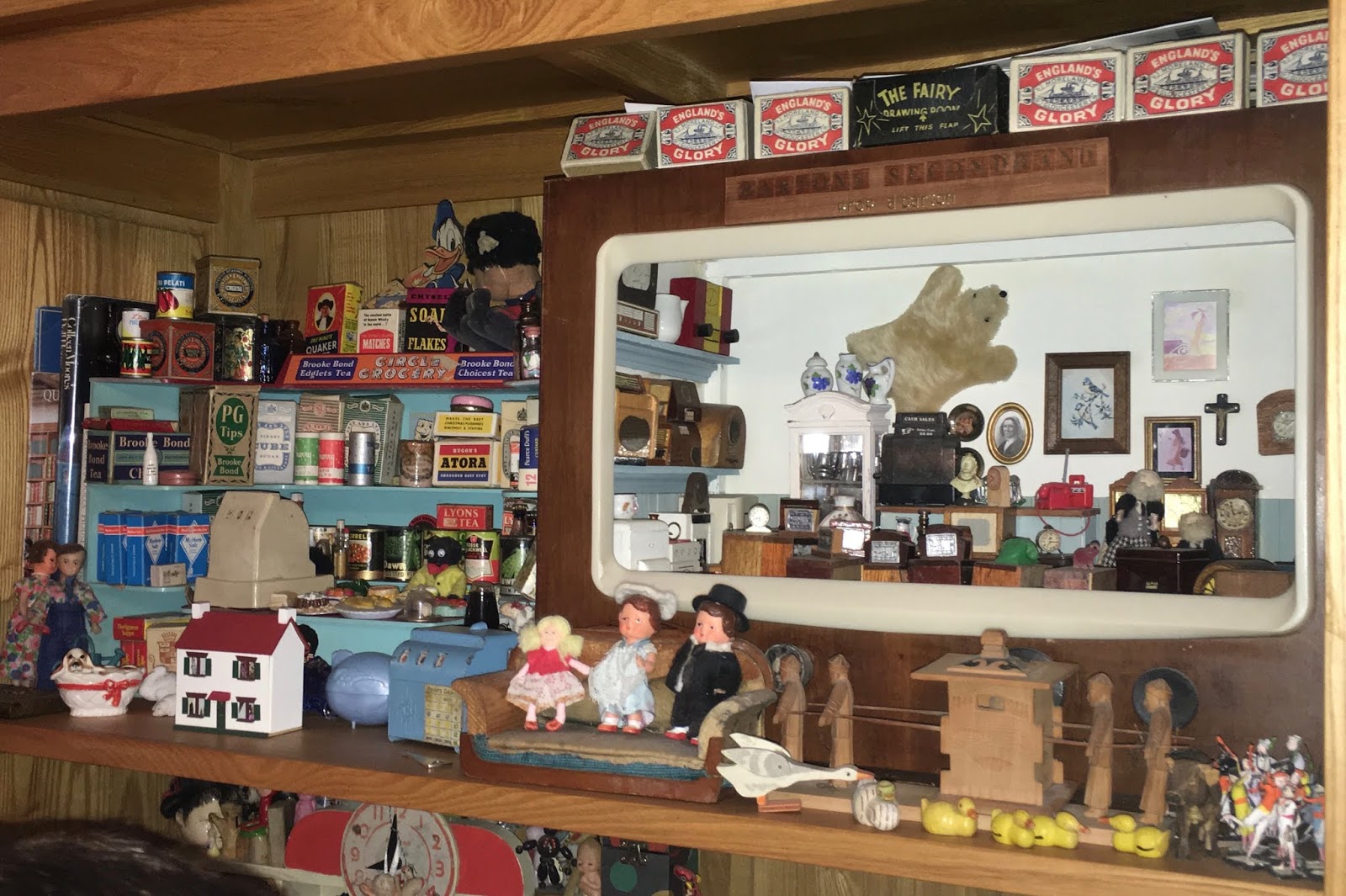

And a Kaybot Wheeler grocery store next to a vintage radio which has been cleverly converted into Bartons Second Hand store, owned by Grecon grandpa Albert Barton.


A Jenny Wren shop just like my own little treasure. And more tiny things.


And finally, at least for the purposes of my blog, a little cabinet packed with some of the most beautiful dolls' house silverware, glass, china and more - something for everyone to drool over in here, I think! 

One of the fantastic things about Claire's collection is that she has built it up steadily over many years; scouring car boot sales, second-hand stores, charity shops, fairs and eBay to find the most amazing items at bargain prices - oh that I had her eye for tiny treasures lurking in dark corners!!

So, there we have it - Claire’s wonderful collection, or at least some of it - trust me, there was more!

Thank you to Claire for sharing it and for allowing me to blog about it. I really hope to see it again one day so that I can spend many more hours taking it in. 

❤️

In my next blog I'll show photos from another fabulous but entirely different collection we viewed during my visit to Cornwall.

Until next time,
Zoe

Monday, 18 February 2019

Resurrected Furniture

So, what else did I manage to resurrect from the box of bashed up old bits shown in my last post?


There were these two German chairs. I still need to fit a new cross-piece on the top of the right-hand one.


There was this lovely silk-covered chair.

There are actually parts for three of these, but I only managed to get one whole one. I should be able to restore at least one more (hopefully all of them), but I'll need to make the missing parts so that's a project for another day...


I love these little chairs. Again, there were another two incomplete ones in the box and I hope I'll be able to restore those one day too.


I'm very, very pleased to have been able to fix up this lovely towel rail. I've wanted one of these for the bedroom in my Turnbull for some time.


I like this useful table too. It was in six pieces and had a leg missing. I used another, lone leg from the box to fill the gap.

I took the photo above specifically to show the replacement leg and it's actually much less obvious when you see it in a room setting.


Another little treasure is this bamboo chair. I found the missing strut for the seat-back in the box. One of the arms was broken and needed to be glued and pinned back in place.

The stretchers between the legs were missing too, but I had a bamboo placemat in my stash (I knew it would come in useful for something one day!) which did the job perfectly.


And finally, this smoker's/captain's chair has had some temporary repairs, though it's still missing a back leg. It's a simple piece but I find it really charming, so I'll be looking out for a replacement leg and will try to make a better piece for the end of the arm when I have some more time.

As you can probably tell, I thoroughly enjoyed my weekend of restoration and it's given me a huge feeling of satisfaction to save a few old pieces from the dustbin, and to share them with you on my blog.

Until next time,
Zoe

Gottschalk Chair

To continue on from my last post, apart from the Erhard & Söhne clock, the thing I'm probably most pleased with from my box of broken furniture, is the Gottschalk chair I've restored.

Got to be Gottschalk!

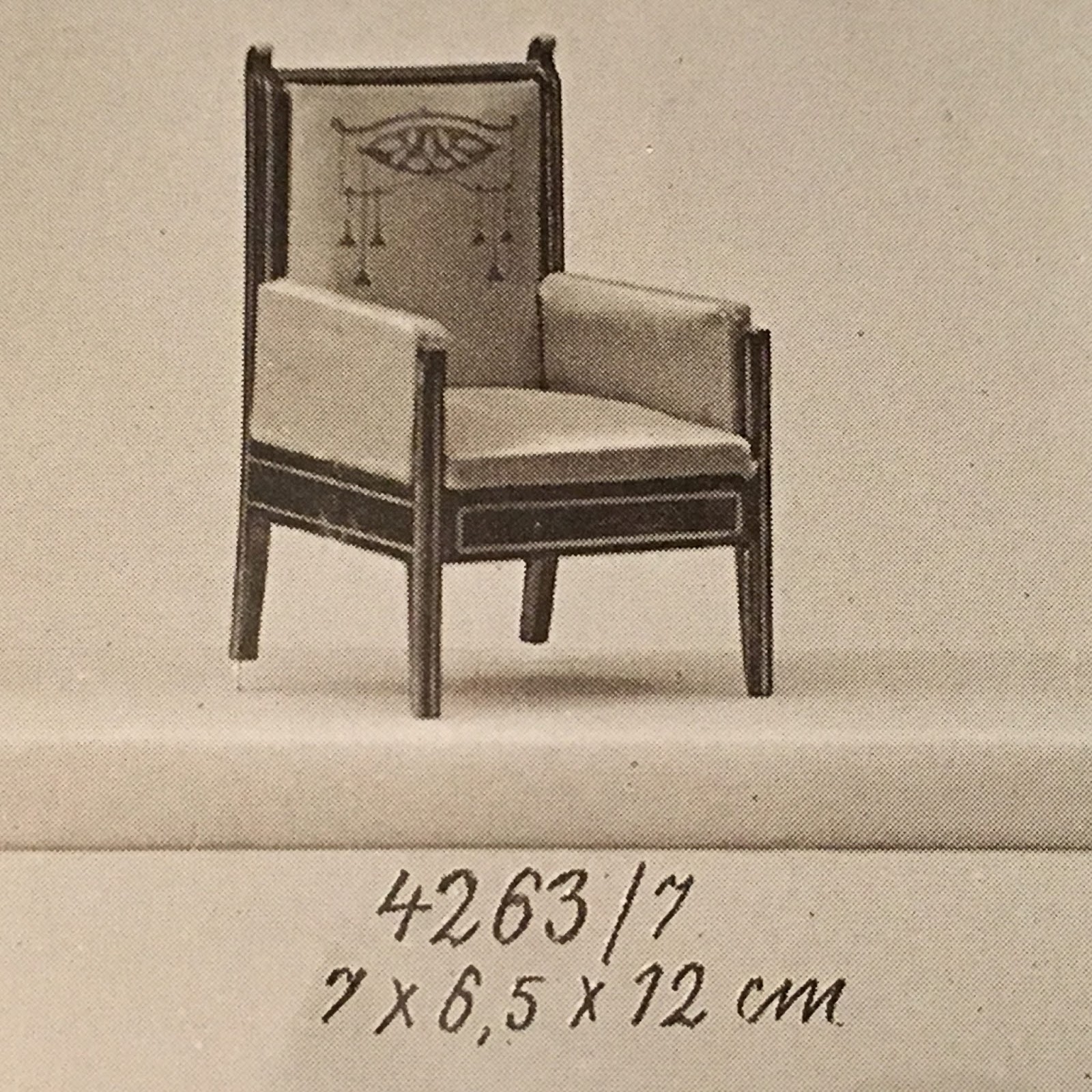
I spotted the padded silk upholstery in the box and felt sure I'd seen it in Marianne Cieslik's extremely useful book of Gottschalk catalogue reprints: Moritz Gottschalk 1892-1931 (2000) - I'm sure I'm not alone in having memorised the photos in half the dolls' house books ever published!

The chair in the 1908 Catalogue in Cieslicks Reprints:
'Moritz Gottschalk 1892-1931' (2000)

And there is was in the reprinted 1908 catalogue. 


I then realised that most of the frame was there in the box too. In terms of the wooden parts, only the front right leg/arm was missing.

Surely I could replace one piece of wood and sort out some upholstery!


I started by cutting down and sanding an old piece of wood to the correct shape for the missing leg. 


Luckily, I found this pot of gloss paint in the extensive selection my husband has in connection with his model railway hobby.  I had to add a touch of black to darken it a tiny bit, but otherwise it was a perfect match.


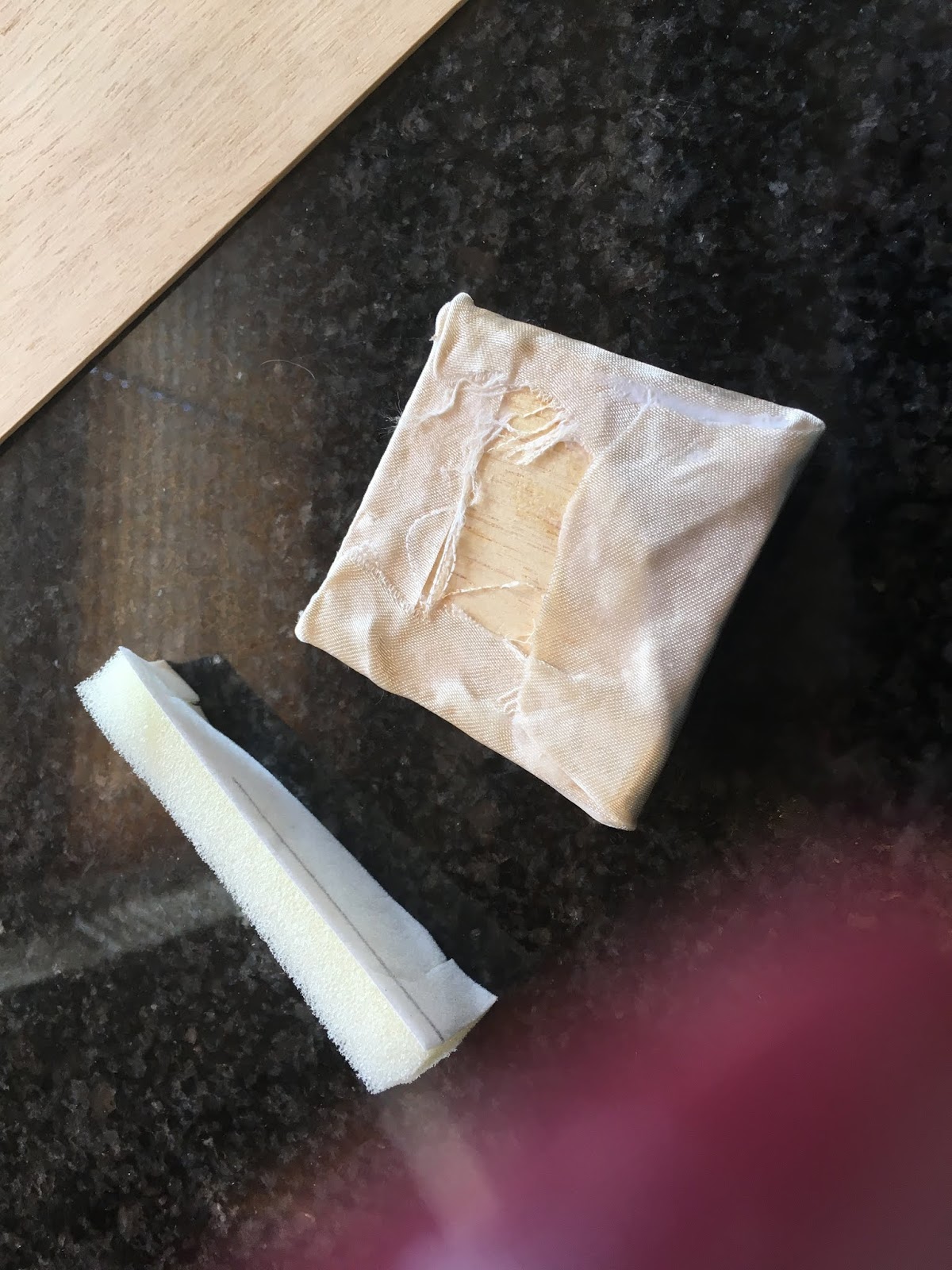
The upholstery was comparatively easy. I cut a thin piece of plywood to the shape of the seat and glued some foam to it.

I then wrapped it in some antique cream silk I had in my stash and glued it on the underside.


Next I cut out some thicker balsa wood to form the arms of the chair. I stuck some thin foam to the inside of these and covered them in the antique silk too.


And here it is fully assembled. I used a gold Sharpie pen to do the lining on the replacement leg/arm.


Of course it's not perfect, but it's much better than I'd hoped for and I have to admit to being quite pleased with it!


Here it is sitting very happily in the study of Southsea Villa (restored C.E. Turnbull house, c.1900). 

Still more to come about the other items resurrected from the box of broken bits...

Until next time,
Zoe

Erhard & Söhne Clock

I recently bought a box of broken dolls' house furniture on eBay for £25 plus postage.

I love a challenge and the idea of breathing new life into unwanted bits and bobs, so I've spent the last few days doing just that.

More of that later, but first - the clock!

Broken furniture after my first sort through the box.

The reason the cost of this box of broken bits didn't put me off was that I'd spotted a little Erhard & Sohne clock in the seller's photographs. And here it is:

Erhard & Söhne Clock

I recognised the clock from Swantje Koehler's excellent book Ormolu Dollhouse Accessories - Metal Toys from the Erhard $ Söhne Company, (2007).

As you can see, it's missing its pendulum and only has one clock hand, otherwise it's not in too bad condition, especially considering it's about 100 years old.

Made for it or does it fit by coincidence?

Also in the box, were three pieces of wood which pieced together to make what looks like the front of a grandfather clock. The Erhard & Söhne clock slots into the top perfectly.

Is this a coincidence or was the clock case (if that's what it is) made for this clock?

There are certainly no photographs of the clock within such a case in Swantje's book, and I haven't found anything like it on the internet either.

The casing could be home-made, of course, though it's certainly been made by an excellent woodworker as the beading around the opening is extremely fine.

As a mantle clock in Southsea Villa

Well, no matter. For the time being, the clock will grace the mantelpiece in the dining room of Southsea Villa (restored C.E.Turnbull house c.1900).

Of course, if anyone does happen to know more about the maybe clock case for it, I'd love to hear from you.

More soon about what I've managed to salvage from the box!

Until next time,
Zoe

Sunday, 10 February 2019

Dolls' Houses in the York Castle Museum

Hoorah - I'm blogging again after a too-long absence - it feels good!

Yesterday, my friend Jenny and I visited the excellent York Castle Museum to view the early 18th century Heslington Baby House.  Our visit was a tale of two parts:

PART ONE

We were a bit disappointed to find that the Baby House is currently being displayed as part of a Georgian room setting and is situated at the far side of the room which can only be viewed from a barrier at the entrance.
The Heslington Baby House, 1700-1720*
(A.K.A The Yarbugh Baby House)

*Dates displayed on the information card for the baby house at the museum.

The distance from us, together with the necessarily low lighting in the museum, made satisfactory viewing of the rooms and contents impossible.


Additionally, three of the rooms couldn't be viewed at all because the opening fronts were closed.

One of the very helpful museum staff members told us that the museum does try to move exhibits about so that they are sometimes in room settings but at others they are behind glass and more easily viewed. However, being extremely heavy, the baby house isn't moved very often due to concerns about damaging it.

I think we must have looked very disappointed and a tiny bit desperate too because the member of staff also casually mentioned that the room in which the Baby House is situated is alarmed!

Now I don't particularly like blogging without photos, but we really couldn't see much and, not surprisingly, I didn't get any decent photos, so I'll keep this part brief, but I must mention something that made me chuckle when I was reading up on the house after our visit.

A photo of a photo of the unusual kitchen in
 Constance Eileen King's book (mentioned below).

The Heslington Baby House is the same house referred to as "The Yarburgh Baby House" in Vivien Greene's Family Dolls' Houses (1973) and in Constance Eileen King's The Collector's History of Dolls' Houses (1983). 

In her book, Vivien Greene provides some information about about the Yarbugh family of Heslington Hall and a family marriage to the eminent architect Sir John Vanbrugh.  Despite a lack of any concrete evidence, she concludes that it is:

"...likely that he [Vanbrugh] designed the Baby House for her many young sisters at an earlier date.." 

Ten years later, in her book, Constance Eileen King delivers a sharp reprimand to Vivien when she writes:

"Vanbrugh's style has been optimistically detected in the arched door, a favourite device, and used to perfect effect in the Orangery at Kensington Palace, and also in the shape of a shallow display-niche in the dining-room, but these designs were so basic to hundreds of country craftsmen, usually making only the most primitive furniture, that they can hardly be used as proof of the master's hand. One can only imagine the chagrin of an architect as fastidious as Vanbrugh at having such a clumsily structured edifice linked with his name."

and she later adds:

"The constant desire among doll's house enthusiasts to link the names of great architects to the models is almost always unfortunate. The houses are charming objects in their own right and hold just as much historical interest when they stand without improbable attributions such as Vanbrugh."

Ouch! I don't suppose that went down well. But I must say that I do agree with Ms. King.

PART TWO

This part of our visit was much more rewarding than the first!

A complete surprise to me was the existence of a second, later, but totally fabulous dolls' house on display at the museum - Dulce Domum (Sweet Home in Latin).

Dulce Domum, c1885.

This house was much easier to view as it was displayed behind glass, and it was just wonderful!

The name of the house and the initials of
Phyllis Dulce Warwick above the entrance.

There was no information about the house on display, however, we were told by another helpful member of staff that it was given to Phyllis Dulce Warwick in 1885, though curiously, that date doesn't tie in with the 1891 Census in which Phyllis is listed as being three years old. She is also listed as being thirteen years old in the 1901 Census.

Anyway, unless I have the wrong Phyllis Dulce Warwick entirely, she was living at Chantry House, Newark when she was three but her family moved to Upton Hall, near Southwell, Newark soon after and that's where she spent the majority of her childhood. Her father was a brewer in the the family business.

I wonder how the house ended up in the York museum.

The original fancy brass light-switches on the side of the house.

We were also told that the house was unusual in that it was electrified when it was made and it therefore had electric lights well before many real houses had them.

Being behind glass made it a little difficult to photograph the house, but here are the best of my photos:

Four storeys and eleven glorious rooms!
Bedroom - top floor left. 
Bedroom - top floor right.
Landing - top floor centre. 
Bedroom - second floor left.
Extra-wide Drawing Room - first floor left.
Drawing room - first floor right.
Dining Room - ground floor left.
Kitchen - ground floor right.
Hallway - ground floor centre.

And finally, a few close-ups of some of the treasures:

Colourful treen (?) in the dining room.
Beautifully shaped and decorated plant pot in a bay window.
A very sweet and tiny pug on a cushion.
A very grand-looking clock. 
One of several fabulous treen sets.
Matching side tables in different rooms. 
An utterly gorgeous set of upholstered metal dining chairs and matching rocker in the large drawing room. 
I hope you enjoyed this tour and if you ever find yourself in York, I can strongly recommend a visit to the Castle Museum which has many other interesting exhibits exhibits - Jenny and I ran out of time and plan to go back again soon.

Until next time,
Zoe