Saturday, 6 June 2020

Erhard & Söhne Treasures

There is something very appealing about the rich gilding and stylish detailing of the lovely antique German dolls' house furniture and accessories from Erhard & Söhne.

This is probably why their ormolu pieces [often referred to as gilt in the UK] usually come with an eye-watering price tag, so I was chuffed to bits recently to find two very nice pieces of it at a very reasonable price.

I recognised them immediately as being by Erhard & Söhne as one of the many books I regularly drool over is this excellent book by Swantje Koehler [helpfully written in both German and English]:
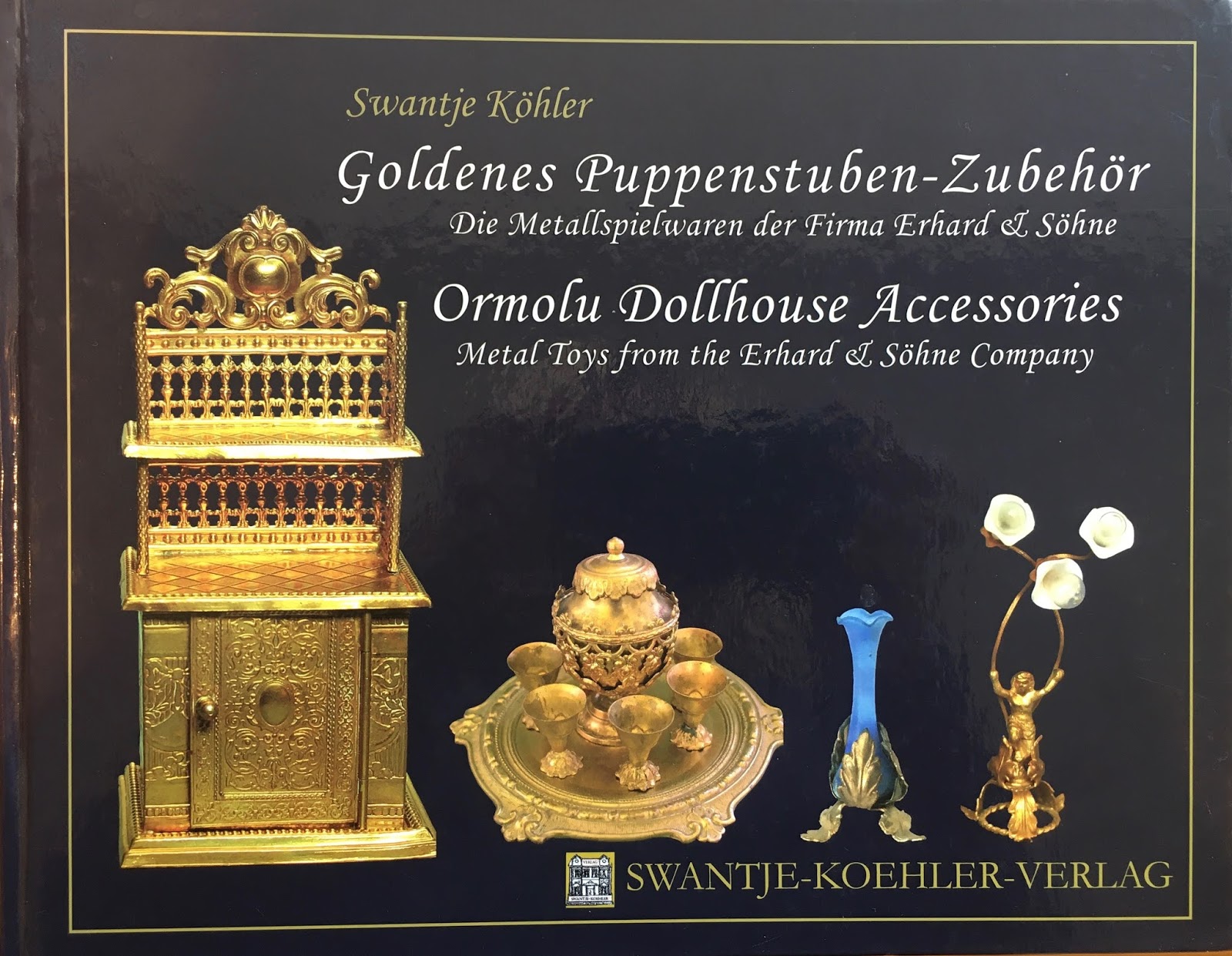


The book provides an excellent history of the company and also reprints three of its black and white catalogues which appeared between 1900 and 1925. It also includes beautiful colour photographs of known examples of some of the catalogue pieces.


So, which pieces did I find? 
___________________________________

The first is this lovely little medicine cabinet/chest:


Erhard & Söhne Medicine Cabinet - Catalogue No. 3597.

It appears in Swantje's book in both Catalogue B (undated but from between 1900 and 1925) and Catalogue C (1925).

It also appears in Catalogue A (1900), but the door handle of that one is shaped more like a tied bow, so I assume that mine is post-1900.

Inside with contents.

Happily, it came with a variety of bits and pieces appropriate to a medicine cabinet.

The door handle turns a little catch on the back of the door to keep it closed.

Inside without contents.

The inside is lined with a lovely green silk/satin fabric.


Back of the cabinet showing bent-over hanging loop.

The body of the cabinet feels like stiff card and the outside is also covered in green silk/satin fabric.

The little hanging-loop has been bent over so as to be invisible from the front. I guess this is because it isn't actually much use for hanging the cabinet, being on the front edge rather than the back - I'm really not sure how you would hang it from the loop unless you had an enormous nail sticking out of the wall!

The dimensions, excluding the hanging loop are: H 7.4 cm x W 5.5 cm x D 2.7 cm.


Close-up of the contents.

The two rolls of lint and the taller bottles look like those shown in the photo in Catalogue B in Swantje's book.

The two smaller bottles labeled 'Spirits' and 'Pulver' (powder) are shorter than those in the catalogue picture, so possibly aren't original, though they are very nice and each has a cork, though one of them has fallen inside the bottle.

I'm not at all sure that the non-working scissors (possibly made from tin) are original to the cabinet either.

The contents in the earlier Catalogue A picture and the later Catalogue B picture in Swantje's book show the lint in little unwrapped piles, so it looks likely that my cabinet dates somewhere in between 1900 and 1925.
___________________________________

The second piece I found was this little hanging bookshelf:

Erhard & Söhne Bookshelf - Catalogue No. 3310/1.

This appears in all three of the catalogues in Swantje's book but I'm thinking maybe it would have been bought at or about the same time as the medicine cabinet.


Shelves without the books to show the pattern.

The shelf could also be bought without the books as Catalogue No 3310.


Two different sets of books, each comprising volumes 1-5.

The sets of books are hollow, being constructed from thin hardboard (or cardboard) covered in the same type of paper that many real books were.


Erhard & Söhne: Bookshelf Catalogue No. 3310/1 and Shelf Catalogue No. 3390. 

I already had a smaller version of the shelf but without books and the difference in size and pattern can be seen in this this photo.

I can see in Swantje's book that the shelves could actually be bought in three different sizes and each with or without books:
  • Larger size (catalogue no. 3311 and 3311/1): this had a candle sconce on each of the top front corners and, if bought with books, each set had five volumes, the same as for the medium size but presumably the books were bigger.  I don't know the measurement of the larger shelf.
  • Medium size (catalogue no. 3310 and 3310/1): as seen above. Dimensions: H (including hanging loop) 7 cm x W 5 cm x 3.7 cm.
  • Small size (catalogue no. 3309/1): as seen above. If this piece was bought with books, each set only had four volumes. Dimensions: H (including the hanging loop) 5.7 cm x W 3.2 cm x D 2 cm.

The catalogue photos show that the pattern on the larger size was different again from either of those in the photo above.

Added 5th July 2020:

The largest size of shelf - with candle sconces.

I just came across this photo that I took last year of the largest sized shelves in a room in the Hammond House in the National Trust’s Wallington Hall collection in Northumberland.
___________________________________

I'm really just recording my research into my own pieces here, but I hope that what I've written has been of use/interest to anyone who finds themselves here for their own purposes, research or otherwise!

Over the years, I've managed to find quite a few Erhard and Söhne pieces and mostly at very good prices - though I have to confess to two pricier purchases! - and I'd really like to record them all here, but that's for another rainy day.

Until next time,
Zoe

Wednesday, 22 April 2020

Biedermeier Sewing Table Repair

Having extra time on my hands due to the Conovirus Lockdown, I’m on a bit of a roll with my long list of restoration projects.


This Biedermeier-style sewing table was missing its lid and, working from photos of an identical but complete example, I decided to make a replacement.


I started by adding the little cushioned middle section inside using a block of balsa wood covered in a piece of old red cotton velvet, and I re-covered the little pin cushion at the front to match too.

The fabric on these sections were red in the photos of the example I was using as a guide and when I removed the faded pin cushion section of this piece, I was pleased to see from the fabric underneath that it had originally been red too, albeit a slighter darker shade than this one.


The next step was to make the lid.

I’ve had a bag of wood veneer offcuts from Hobbies in my stash for many years and I found one that had a matching grain.

I cut a piece to the correct size for the table top. The lids of these tables have a large overhang over the front and sides of the bases so the size didn’t need to be too precise, though making it with good square corners was essential.


Next I laminated an identically sized piece of hardwood with the veneer.

I did this by sticking the pieces together with wood glue and sandwiching them between two pieces of wood which I then clamped together to form a press. I left the pieces in the press until the glue was thoroughly dry.


Two coats of Dark Oak varnish on the veneer, followed by a good French polish and the top matched the bottom quite well.


Being limited for suitable wood in my stash to make the edges of the lid, I made do with a couple of coffee stirrers which were fine after a bit of sanding.

I painted them with matt white Humbrol enamel paint on the side which would be on the outside and matt metallic gold Humbrol paint on the inside side and the edges, to match the table in my reference photos.

Gluing the edges to the top piece was fiddly but I got there in the end.


The sewing table in the photos I was referencing had a mirror set in the inside of the lid, however, I didn’t have a suitable mirror so I decided to use a piece of vintage silk as a temporary measure - the hope is that one day I’ll find the right size mirror and will be able to replace it.

I neatened the edges of the silk by sticking on some embossed paper to echo the edging around the sections of the sewing box.


I attached the lid to the base of the table with a piece of ribbon glued on to the top and base with fabric glue and then painted with matt metallic gold Humbrol paint.


Filling the individual sections up with scraps of ribbon and tiny sewing notions really brought it to life.


And here’s the finished piece in situ with the lid open.....


 ...and with the lid closed.

I’m very happy with how the whole thing came together and to have given a good but broken piece of antique dolls’ house furniture a new lease of life.

Until next time,
Zoe


Friday, 17 April 2020

Bassett-Lowke Nuways Sink Restoration

I bought this sink a while ago.


They don’t come up for sale very often and are usually quite expensive when they do. This one was a bit cheaper because the taps had broken off and attempts to stick them back on had left the ‘tiled’ splashback in quite a mess. However, the good news was that the broken-off original taps came with it so I knew I’d be able to restore it. Today I finally got around to it.


I started by cleaning off the rock-hard residue of epoxy resin, or whatever it was that had been used in past attempts to reattach the taps. I used a sturdy scalpel and tried to avoid too much damage to the enamel paint, however, some damage was inevitable and would have to be touched up later. I also cleaned some bits of residue off the taps with a small file.


Next, I helped my husband to solder the taps to the piece - I held the taps in place with tweezers while he did the tricky soldering bit! Because the taps are made of white metal, it was important to use a low-temperature soldering iron and low-temperature solder to avoid melting them!!

The original plug and most of the chain were missing when I bought the sink. The short piece of chain that remained was extremely fine so I used the finest piece in my stash of jewellery findings. It was a little chunkier but didn’t look out of place so I attached a length of it to the tiny loop on the splashback.  

I then had a huge stroke of luck when, there in my button box was the perfect little metal stud to use as a plug. I glued the end of the chain to the stud with a drop of clear Gorilla glue.


It sits perfectly in the plug hole.

Next, I touched up the paintwork, just enough to hide the damage. It’s not perfect but I’d rather that than have the piece look over-restored.

Added 18th April, 2020: After I posted this blog yesterday, I realised the sink might be missing some wooden draining boards. The catalogue picture of the sink shows them, but I’ve only seen two actual sinks and one was with and one without so I wasn’t sure and decided to make them removable. [NOTE: the original did have removable draining boards as confirmed in the catalogue description which I’d completely missed! - see comment from Jenny below.]


In any event, I decided to go for it and made some from a piece of old wood I had. I’ve only attached them with tacky wax so as not to cause any damage to the piece.


I’m very pleased with the final result and it’s great to have a complete-looking sink. Here it is in its new home in the kitchen bay of my G&J Lines No. 33/‘Half-size Kits Coty’ (c1909-10).

More information about Bassett-Lowke Nuways dolls’ house furniture can be found on the Brighton Toy Museum website here and my article in the Dolls' Houses Past and Present online magazine here.

Until next time,
Zoe

Saturday, 14 December 2019

Michael Mortimer Fire Surround

I’m delighted to have identified a wooden fire surround I bought secondhand about three years ago from eBay.


It was made by the talented miniaturist Michael Mortimer. [I added the blazing fire in the hearth.]

I bought it because I loved the realistic old oak grain effect of the wood and because I thought that, despite being a relatively modern miniature, it would suit my old German chalet very nicely.

I had no idea who had made it but knew it was very nicely made.

Curiously, at the time that I bought it, I posted a photo of the room I had placed it in on the Dolls’ Houses Past & Present website and a member commented: “Does the fireplace have a maker’s name - or gold squiggle on it? The smoothness and fake holes are ringing a bell in my fuzzy mind” to which I replied “No, no marks on the fireplace at all, sadly.”


And yet I just looked at the back and there are these marks!!

I can only think that I didn’t distinguish between these marks and the glue residue on it from where it must have previously been attached to a wall - maybe my contact lenses are better these days!

Well no matter, whatever the reason for my temporary blindness, I now know that the marks are those of Michael Mortimer because last week I was browsing eBay in a spare moment (as you do) and I spotted a lovely secondhand Welsh dresser with the same distinctive finish as my fire surround. The dresser was a signed piece by Michael Mortimer.

This led me to Google Michael Mortimer and eventually I discovered a very similar fire surround of his which had been for sale on the US site dollhousejunction.com.

Interestingly, most (if not all) of the photos of pieces of Michael Mortimer furniture that I found online had this comma type mark (the top mark in the photo above) with a heart underneath it, whereas mine has this intriguing wiggly L-shaped mark underneath. I wonder what, if anything, the two different marks denote. [**I now have more information on these marks from Michael himself - see my footnote below, added 2nd January, 2020.]

By the way, I’m posting this blog entry mainly to make sure that I remember this discovery as it’s pretty scary what information I seem to have discovered and then subsequently forgotten in the last few years - not to mention the makers’ marks I may or may not have noticed...!

Until next time,
Zoe 

(But do read on because there is almost as much added to this post below as there is on the post itself! 😀)

[Added 1st January, 2020: I discovered today that Michael has a shop on Etsy and that the pieces for sale there are signed with symbols more like those on my piece. He mentions too that since 1996, “every piece (mostly)” he has made has had a message attached to it, printed on paper and stuck to the back. The messages are things he made a note of if he: “heard something, read something, or just generally picked up on something that felt too important to overlook”. I think he might have only started selling miniatures about 1996*, so perhaps my message-less piece is one of his very earliest, from before he started to add them, though “most” suggests that some do go out without messages so it could be later, and of course, it might have had one which was subsequently lost or removed.

*The reason I think Michael might only just have started selling miniatures around 1996 is that, by sheer coincidence, I was reading an old issue of ‘Dolls House World’ from October 1996 yesterday and saw this enigmatic advert:


Although Michael’s business seems to be based in Checkendon in Oxfordshire these days and not Honiton in Devon, I’m assuming, because of the symbol used and the reference to 16thC style furniture, that this was his advert and, as you can see, it refers to the business having “begun”, presumably as in ‘just begun’***.]

[Added 2nd January, 2020: Following the discovery of Michael’s Etsy shop yesterday, I messaged the man himself to ask if he’d be kind enough to take a look at my blog post and let me know if the information I had gleaned was correct, and he was indeed kind enough! So, thank you to Micheal for letting me know that:

My fire surround is an older piece of his and, though he couldn’t remember exactly when it was made, he would guess that it was before 2000 because he has been adding a plaster moulding to the front of them (as seen on the one sold by dollhousejunction.com) for quite some time now.

**The squiggle on the back is his signature and the top bit represents a nine, not a comma as I had thought. The reason why he chose are nine? Well, he says it: “is a whole different story, and I’m not sure I can really explain that!”

**More recently, Michael has put a heart under the ’9’, but he has also changed this quite a few times over the years and still does - it doesn’t denote anything and is just him “seeing if something else feels better”.

He has been adding the messages, or phrases, for a long time too, but there have been periods when he has left them off.

***The advert from the October 1996 ‘Dolls House Word’ magazine (shown above) was placed just after Michael had moved from Sussex to Devon and changed his business name from ‘Michael Mortimer’ to ‘9’, hence the use of the words “has begun”. Michael said: “it felt like a new start”, but the new start was in name and place only as the furniture was the same that he’d been making since he started which was actually around 1991.

Michael moved from Devon to Oxfordshire in 2006.

Wednesday, 24 April 2019

The Most Amazing Lines/Triang Dolls' House Collection!

As promised in my last post, this post is about a private collection that I had the privilege of viewing recently with my friends and fellow collectors Claire and Brooksey.


The collection is owned by a couple with a passion for G&J Lines and Triang toys and their collection is VAST!


Filling several very large, two-storey outbuildings, the collection includes not just Lines and Triang dolls' houses but just about every toy that Triang manufactured, including dolls, dolls' prams, rocking horses, pedal cars, model cars, aeroplanes, ships, forts, trains, garages....and so on!


Mr Triang Collector seemed to have a particular passion for pedal cars and this photo and the one below show only a fraction of his collection of them.


It's possible that this is the largest collection of Triang pedal cars in the world, however, we were told that the largest collection of pedal cars generally is held by one George W. Bush... well you learn something every day!


As far as dolls' houses are concerned, I took photographs of about sixty individual houses but that would, I think, be less than a quarter of those on display.


Our eyes out on stalks, we were shown room after room of fabulous houses. At times we were speechless - now that doesn't happen very often!


I had never stopped to imagine what all [or nearly all] of the Lines/Triang houses would look like if they were all gathered together and displayed in one place.


I can't possibly include all of the photos I took in this post - it would be HUGE - so I'll have to limit myself to some of my favourites and maybe some of the less often seen models.

Then again, how do you single out favourites and rarer models from amongst a line up like this!


OK, well I'll start with this one. I assume that this pretty little house is an early G&J Lines model but it also has a look of Gottschalk about it, which is not surprising as there was a lot of copying going on between the major manufacturers at the start of the 20th century. The windows on the far side (only just visible in this photo) are quite an unusual feature.


It really was lovely to see some of these earlier G&J Lines models 'in the flesh'. The big house in this photograph is [I think] the No. 25 which came with its own garden (c1909-10)

The smaller house on the far side of it is the G&J Lines No. 13 (also c1909-10).


This is a model I'd never seen before. It’s an early Triang DH/2 (1919-21). I love the design! [This model number was used again between 1927-33, for a different design).


More familiar is this G&J Lines No. 17 - the front-opening version of the side-opening No. 17 I own myself (c1909-10).


And a fancier version with no less than three balconies (presumably also dating to about1909-10).


I can't recall having seen a model quite like this one before. It's similar to the much-loved Kits Coty (c. 1909-10) but with a number of distinct differences.


Another G&J Lines, this one is a No. 31(1909-10).


And a G&J Lines 'Clock House' (again from around 1909-10).


This is the lovely four-storied G&J Lines No. 73 (c1915) - I hope I'm getting my facts right here!


And this magnificent mock-Tudor mansion, G&J Lines No. 80 (c.1925) opens front and back and has eight rooms.


I'm not sure I've seen this model before. It's similar but not the same as the Triang DH/5 (1919-21)*. It also looks rather like the house that Marion Osborne shows and describes at the start of her Lines and Triang book as being attributed to G&J Lines from about 1900, however, that information might well have been superseded by now (and I look forward to Marion's new Lines book which I understand is not too long away now!) - *THIS IS NOW KNOWN TO BE A TRIANG DH/5 - SEE FOOTNOTE FOR UPDATE!


The beautiful Triang DH/10 with wonderful fancy timbering (c1934-35).


This sweet little Triang cottage known as 'The Queen's Dolls' House' (1922-30)


I'd never seen this cute DH/H 'Country Cottage before (c1924).


And this Triang DH/2 bungalow isn't seen very often either (1927-1933).


I do like these rarely-seen Triang No. 45s which are similar to the 'Ultra Modern' but with a more traditional pitched roof (1936-40).


Here we have a No. 55 from the Triang Mayflower series (1928-1933).


And a No. 54 from the same series.


This is a Triang No 64 which was the largest of the 60 series at 45" (1.13m) wide (1933-1944).


It's not often you get to see the little Triang Bungalow No. 32, (1930-41).


And there was this lovely example of the No. 71 (1932-36), often referred to as the Half Stockbroker.


Well, I could go on because, as you can see, there were many, many more fabulous Lines and Triang houses in the collection but I really can't cover them all.

Before I end my post though, I do just want to cover a few of the other interesting not-quite-dolls' house toys that were on display:


Like this wonderful Triang greenhouse - something I have hankered after for a long time.


The little Triang cold-frame.


The fab Triang houseboat!


The equally fab Triang motorhome!


The Noah's ark.


The carriage and horses for your dolls!


A Wendy-house sized Triang shop - oh how I would have LOVED this as a child!


Literally the Rolls Royce of Triang pedal cars.


And finally, something completely different since it's neither Lines nor Triang - this is Mr Triang Collector's working steam train. To give you an idea of scale, if I was stood on the footplate, only my head would be visible over the canopy bit and I'm 5'8"!

The train runs on a miniature railway which loops around the sizeable garden. Living the dream eh!

So, that's it from me - needless to say, we had a fabulous afternoon viewing the collection and I can honestly say that it was beyond my wildest expectations!

Until next time,
Zoe

With huge thanks to Mr & Mrs Triang Collector for allowing us view the collection and also for giving me permission to blog about it. 

With thanks also to Marion Osborne and the Dolls' Houses Past & Present website for providing the information I needed regarding model numbers and dates - apologies if I've missed or mis-interpreted anything!

UPDATE:

The dolls' house referred to above as "similar but not the same as the Triang DH/5 (1919-21)" is now known for certain to be Triang DH/5 and NOT a G&J Lines house. The only model I had seen previously did not have a dormer window, but it is now known that they were produced with and without dormer windows. There is a good example of the DH/5 with a dormer window in the Dolls' Houses Past and Present Triang Database which can be seen here.